

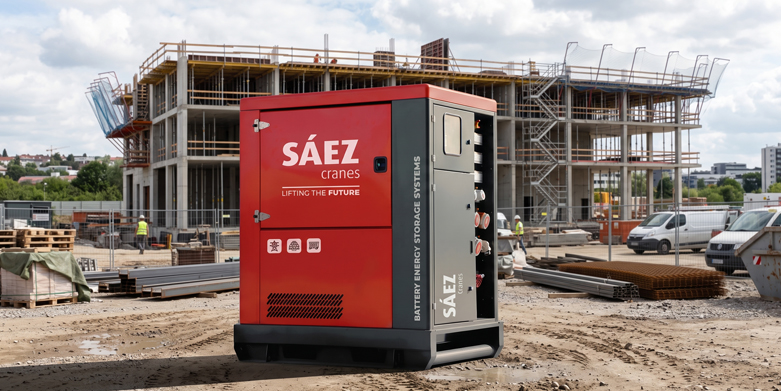
Grúas Sáez is introducing battery energy storage systems for its tower cranes. The battery covers the crane’s power peaks, so the site can work with a much smaller grid connection or generator and use less diesel.
At a glance:
- Smaller grid connection: depending on the crane model, the system charges from a 230 V single-phase socket, with no need to contract a high-power three-phase connection just for the crane.
- Compact generator: without a grid connection, a generator of around 20 kVA is enough (as a guide).).
- Less diesel, less noise and lower emissions on site.
- Accepts solar panels and can be combined with Sáez’s Eco+ system.
A connection sized for a few seconds of peak demand
A tower crane needs a lot of power for a few seconds, when starting up and lifting the load, and much less the rest of the time. Even so, the grid connection or generator is sized for that peak, and that capacity is paid for throughout the project even though it runs well below capacity for most of the working day.
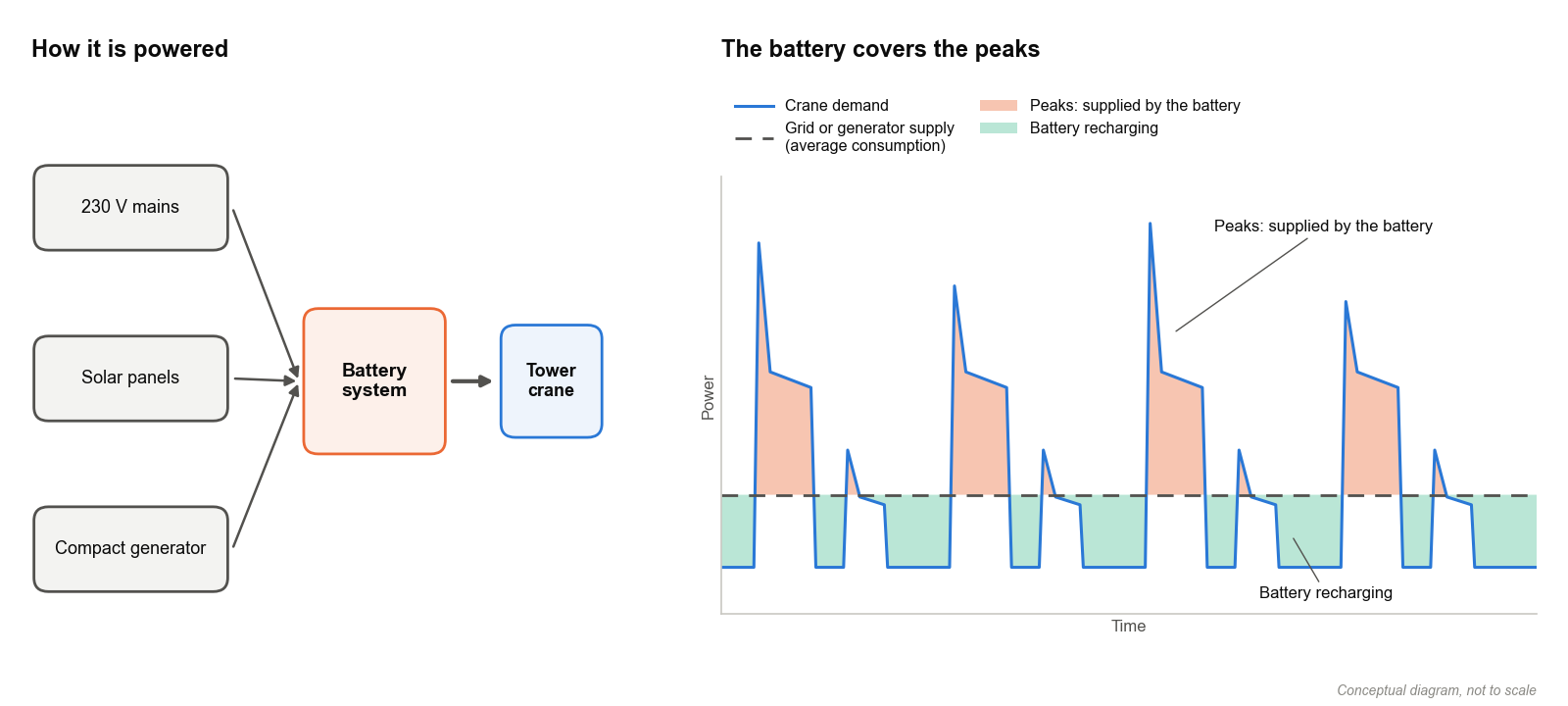
The battery system changes this approach: the battery supplies the peaks and the power source only has to cover the crane’s average consumption.
How it works
The system combines a battery pack with the power electronics needed to supply the crane. The battery is charged continuously from a low-power source and delivers the energy the crane needs at any moment for hoisting, slewing or travelling.
During start-ups and lifts, the battery supplies the peaks; when demand drops, it recharges. The grid or generator only has to cover the average consumption, so the site installation can be sized for that consumption rather than for the peak.
Three charging sources, separately or combined
230 V mains supply: depending on the crane model, the system can be charged from a 230 V single-phase mains socket. This makes installation easier in urban areas or on sites that already have a basic supply.
Solar photovoltaic panels: they provide renewable energy generated on site. Their contribution depends on the location, the time of year and the number of panels.
Compact generator: where there is no grid or the grid is unstable, the system is charged with a small diesel generator, around 20 kVA as a guide.
What the site gains
Smaller grid connection and lower supply costs
By covering the peaks, the system allows the site to contract less power and install a smaller electrical supply, saving on both the contract and the installation of the site connection. With time-of-use tariffs, the battery can also be charged when energy is cheapest.
Smaller generators, less diesel and less noise
On sites without a grid connection, the crane is usually powered by a large diesel generator, sized for the peaks and running at low load most of the time, which is when it is least efficient. With the battery system, a compact generator of around 20 kVA (as a guide) is enough: it charges the battery while running fewer hours and under better conditions. The result: less diesel, less noise, less generator maintenance and lower CO₂ emissions on site.
Solar energy generated on site
The system can be charged with solar photovoltaic panels installed on the site itself. As a guide, with 12 to 16 panels part of the energy used by the crane is generated on site and is renewable; how much also depends on the location and the time of year. Combined with the grid or a compact generator, the panels reduce both the energy drawn from the grid and the diesel used.
Which configuration does your site need? Contact us with the crane model and the site conditions.
Which sites is it designed for?
- Urban sites with a limited supply, where increasing the contracted power is expensive or not possible.
- Sites with no grid connection or an unstable grid.
- Early construction phases, before the permanent supply is available.
- Sites where noise and emissions matter, because of their location or the project requirements.
Sáez efficiency solutions
- Battery system: covers the crane’s power peaks. Less contracted power and less diesel.
- Eco+ system: based on supercapacitors, it recovers the braking energy that is normally dissipated in the braking resistors when lowering loads and braking the slewing movement, and reduces the crane’s energy consumption. It can be combined with the battery system on the same crane. See the Eco+ system
- Eco mode: standard on all Sáez cranes. It allows the crane to work with 25-30% less installed power by halving the hoisting, trolley and slewing speeds.
Shall we talk about your site?
Tell us the crane model and your site conditions and we will propose the right system configuration. Contact Grúas Sáez